Thursday, 23 January 2014

12.7 Phenomena Related to Refraction

12.7 Phenomena Related to Refraction

Apparent Depth

Figure 1.0

Apparent Depth is the depth that an object appears to be at due to the refraction of light at the transparent medium. Our eyes interpret the refracted light as coming from a source along the line of sight. An example would be cleaning a fish tank. When you put the net in to the water to remove the fish, more times than not, you will miss the fish, because, the object is travelling from a less dense medium to a denser medium, it will result in refraction, causing a virtual image, and the net to be bent. (The light is bending towards the normal.) Therefore the fish is appeared to be deeper than it actually is. (see Figure 1.0)

Mirages

A mirage is a virtual image that forms as a result of refraction and total internal reflection within the Earth's atmosphere. Light waves from the sun travel straight through the atmosphere to our eyes. However, light travels at different speeds through hot and cold air. Mirages occur when the ground is hot, and the air is cool. For example; in the desert, the hot sand warms a layer of air just above the ground. When light moves from the cool air medium in to the hot air medium- it is refracted- and therefore bent. The "puddle" that we see appear on the ground is the reflection of the light bending (refraction) from the sky. Therefore the light from the sky appears to be on the ground in front of us, which creates the image of a puddle. See the video provided below, for an in depth explanation.


 Dispersion of Light and Rainbows

Dispersion is the separation of white light into its constituent colours (the spectrum.) Each colour of visible light (ROYGBIV) travels at different speed when it travels through glass prisims. That is why light refracts more than the other colours of the spectrum. Red light is refracted the least of all the colours in the spectrum. This is how rainbows are created in glass prisms. (See Figure 1.1) The video provided below will explain this concept in greater detail.

Figure 1.1


When white light enters a raindrop, dispersion occurs. The seven colours of the rainbow are produced. When this light hits the back of the raindrop, partial reflection occurs. The light continues to refract once it moves from the raindrop into the atmosphere. People only see 1 colour from each drop because the majority of the other colours miss our eyes. Therefore a rainbow is a mix of drops at different elevations. The shape of the rainbow comes from the different angles of refraction that the colours are producing. (See Figure 1.3) Double rainbows occur from two internal reflections, that are always higher in the sky compared to the original rainbow and the order of the colours are reversed. (See Figure 1.4)
Figure 1.4

Figure 1.3


For additional information go to:

Rainbows & Refraction

Phenomenas Related to Refraction

Bending Sunlight


By:  J.C. and M.T.


Sunday, 19 January 2014

12.4 The Index of Refraction


During the study of the light and geometric optics unit, chapter 12.4, we learned the Index of Refraction.

Definitions:

Index of Refraction:
                               The ratio of the speed of light in a vacuum compared to the speed of light in a medium  
                               
Refracted Ray: 
                         A ray that has entered a medium and has bent either away or towards the normal depending of the density of the object.


Mathematically the ratio of the index of refraction is written as;

'N' is the index of refraction whereas 'C' is the speed of light in a vacuum and 'V' is the speed of light in a given medium.

The index of refraction can also be calculated by the using the sines of the angles.

                                                                 N  =  sin i 
                                                                          sin r
Calculating the Index of refraction:
You are given;

The speed of light in a vacuum is

C=3.00 x 10 to the power of 8  meters a second.

You are also given the speed of light in the given substance for example sodium chloride.

V (sodium chloride)  =1.96 x 10 to the power of 8  meters a second.

Solution:
               N  = C
                       V

     = 10 to the power of 8   m/s
      1.96 x 10 to the power of 8 m/s
   
      =  1.53
Therefore the index of refraction for sodium chloride is  1.53.


Calculating the speed of light.
You are given;

The speed of light in a vacuum is C=3.00 x 10 to the power of 8  meters a second.

and the index of refraction in a given substance for example olive oil
where N(olive oil) =1.48

you must then find V or the speed of light in the given medium (Olive oil).

Solution:

N = C           
       N

V x N = C            


V = C               
       V    

= 3.00 x 10 to the power of 8   m/s
               1.48

= 2.03 x 10 to the power of 8   m/s

therefore the speed of light in olive oil is      = 2.03 x 10 to the power of 8   m/s

Snell's Law:
                     
Snell's law is a formula to describe the relationship between the angle of incidences and the angle of refraction.  


Here's a link for a quick lesson on the index of refraction
http://www.youtube.com/watch?v=iuBiZjSHnwI

Here's one for the calculations on the index of refraction.
http://www.youtube.com/watch?v=wuD2pwqyT3Q

Here's one for Snell's Law.
http://www.youtube.com/watch?v=y55tzg_jW9I


Sunday, 12 January 2014

12.1 What is Refraction?

January 2014

In the Light & Geometric Optics unit, we studied The Refraction of Light. 
This is what we studied in Section 12.1.  

In our textbook on page 515, refraction is defined like this:

refraction
the bending or change in direction of light
when it travels from one medium into another

Here is a another way to explain refraction:

REFRACTION is the bending of a path of light.
• A one-word synonym for refraction is bending. Light travels in straight lines.
A bend in its direction occurs when it travels from one material (or medium) into another.
• A light wave is refracted or bent at the boundary of the two mediums that it is travelling through. For this reason, refraction is called a boundary behaviour.

THE REFRACTION OF LIGHT GOING FROM AIR INTO WATER

WHAT CAUSES REFRACTION?
Different mediums have different densities. Density is the measure of how tightly packed the particles are in a substance. For example, air is less dense than water.
• The density of a material affects the speed of light and this in turn, affects the way the light bends so that refraction occurs.

THE RULES FOR REFRACTION
The speed of light changes depending on the medium through which the light is travelling. The light ray that is transmitted (travels through an object) is called
the refracted ray. The angle of refraction is the angle between the refracted
light ray and the normal.

RULE 1
• The incident ray, the refracted ray and the normal all lie in the same plane.
• The incident ray and the refracted ray are on opposite sides of the line or boundary that separates the two media. 

RULE 2
• When light travels from one medium to another, the speed of light will either
speed up or slow down. 
• When the speed of light is slower in the second medium, the refracted ray will
bend closer to the normal.
• When the speed of light is faster in the second medium, the refracted ray will
bend away from the normal.  


LIGHT BENDS TOWARD THE NORMAL WHEN ITS SPEED DECREASES IN A MATERIAL

LIGHT BENDS IN PREDICTABLE WAYS
• When light travels into a medium that is denser, the light is slowed down and bends toward the medium and the angle of refraction gets smaller.
• When light travels into a medium that is less dense, the light speeds up and bends away from the medium and the angle of refraction gets bigger.


A COMMON EXAMPLE OF REFRACTION
When a spoon is placed in a glass of water and viewed from the
side, it appears to be broken or bent.This is due to the difference
in the refractive properties of air and water.

Since water is denser than air, the spoon appears to bend as the
light it reflects is slowed by the density of the water.

This phenomenon also makes submerged objects such as fish look
closer to the surface than they actually are.


PARTIAL REFLECTION AND REFRACTION

Refraction is often accompanied by reflection.
Some of the light that strikes water is reflected off the water, but a great deal of light is also refracted as it enters the water and illuminates the water below the surface.
THE TREE IS VISIBLE DUE TO REFLECTION. THE FISH ARE VISIBLE DUE TO REFRACTION.


CHECK OUT THIS VIDEO for more information about REFRACTION:
CHECK OUT THESE LINKS for more information about REFRACTION:


PRODUCED BY JM

Friday, 10 January 2014

11.9 Blog: Images in Curved Mirrors

The Terminology of Concave Mirrors
A concave mirror, which is also known as a converging mirror is a mirror that is shaped like the mirror is curving outwards. A convex mirror, which is also known as a diverging mirror is a mirror shaped like the mirror is curving inwards. The centre of curvature of a mirror is when the spheres surface is used to make the mirror. The principal axis of the mirror is a line which goes through the centre of curvature and the centre of the mirror.The vertex is where the principal axis meets the mirror.

principal axis


How to Locate an Image in a Concave Mirror

To find out what the image of an object that is in front of a concave mirror, you will have to draw two or more incident rays beginning at the top of an object. The rays might form an image and reflect off the mirror.

  1. To determine the focus a light ray parallel to the principal axis is reflected through the focus.
  2. When a light ray goes through the centre of curvature (C) it's then reflected back onto itself.
  3. When a light ray goes through F it will reflect parallel to the principal axis..
  4. When a light ray is directed at the vertex it will follow the law of reflection. The surface of the mirror is vertical to the principal axis so the angle of incidence will be measured easily.


How to Locate an Image in a Convex Mirror

To find out 
  1. When a light ray is parallel to the principal axis it is reflected as if it went through the focus.
  2. When a ray is directed toward the centre of curvature it is reflected back to itself.
  3. When a ray is directed toward the focus it is reflected to the principal axis.


examples of concave mirrors: a car headlight, a searchlight and a flashlight.
examples of convex mirrors: security mirrors,

Link on how to locate the image in a convex mirror
http://www.physicsclassroom.com/class/refln/u13l4b.cfm


Link on how to locate the image in a concave mirror
http://www.physicsclassroom.com/class/refln/u13l3d.cfm


By: M.B.

Wednesday, 11 December 2013

11.7 Images in Plane Mirrors


11.7 Blog: Images in Plane Mirrors


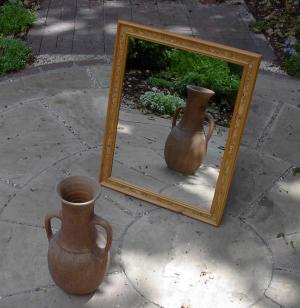
Today in our Science Class we went over 11.7, "Images in Plane Mirrors". We learned many new interesting concepts in this class. First we learned how light rays are used to locate images in mirrors. A light source emits millions of rays that bounce of a mirror. You will only see the rays that bounce back into our eye. Light travels in nothing but straight lines. And when your eyes look at a mirror it seems as if the mirror is a light source but it actually is not. Mirrors are opaque. This is how you see things reflected on to a mirror. These things are called Virtual Images. We also can use this knowledge to create equal perpendicular lines and locate an image on a mirror by ourselves. You just draw the incident ray coming from your object and then you draw your reflected ray. You can easily draw the reflected ray using a protractor without a real light source because we know the angle of incidence and the angle of reflection is always equal.
After this you trace the reflected ray behind the mirror and you can see where the object would be on a mirror by seeing when the extended reflected rays connect. This is really cool to me as you can draw an exact reflection o
f an image by yourself at home just by using a pencil and a protractor! Two observations you can get from this is that the distance between the object and the mirror is the same distance between the virtual image and the mirror. Another thing is that the object-image line is perpendicular to the mirror surface. These are some of the interesting things we learned today about images
in mirrors.

If you need more help understanding and doing this, Watch this interesting video!


Another Important thing we learned in class is how to describe the properties of an image! You can do this by using the acronym called SALT, which stands for:

Size of the image compared to the object
Attitude of the image(orientation)
Location of the image
Type of Image(Real or Virtual)


Overall this was a great class in which we learned many interesting things!
By: U.Q and H.M


Tuesday, 10 December 2013

11.6 The Law of Reflection and Plane Mirrors

11.6 Blog: The Law of Reflection and Plane Mirrors


Diffuse Reflection
Today we learned about chapter 11.6 which was about the laws of reflection and plane mirrors. Light travels in a straight line. A light ray is a line and arrow that represents the path of light. Reflection is light bouncing back from any surface. However a mirror is the most commonly used way to reflect light, in this video it shows us how this is done. A mirror is any polished surface that reflects. Specular reflection (picture) is the reflection of light off a smooth surface. Diffuse reflection (picture) is the reflection of light off a surface that is not smooth.


Laws of Reflection

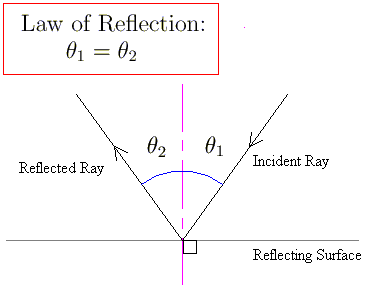
  1. The Incidence angle equals the angle of reflection, so basically the angle between the incident ray and normal is equal to the angle between the reflection rays and normal.
  2. Incidence Angle = Reflection Angle
  3.   The Incident ray, reflection ray and the normal all lie on the same plane


By: N.M. & T.C.


Wednesday, 4 December 2013

11.3 The Ray Model of Light


November 2013,


On 11.3 we learned about the Ray Model of Light. Here’s a  short recap on what we learned from 11.3:


Figure 1


Light rays is  a line that represents the direction and path that is travelling(Figure 1). The use of light rays to determine how light behaves when it strikes objects is called geometric optics. When drawing rays, you do not need to draw it at every angle, you would only need to draw a few like the example shown in figure 1. 


Figure 2 (a) example of opaque, (b) example of transparent, (c) example of translucent
If a emitted light reflects off an object we call it incident light. when the sun emits light and the moon reflecting the light is an example of incident light. A clear material in which you can see through is called transparent . An example of a transparent object would be windows, raindrops, water. A material that transmit lights through but cannot see objects through the material is called a translucent. Example of translucent would be jello, piece of thick plastic, x-rays.  A material that does not transmit incident light is called opaque. Example of opaque is pudding, cardboard box, brick.


Flat Mirrors
Figure 2
A reproduction of an object through the use of light is called an image. Any surface that reflecting a image is called a mirror. when the light bouncing back from a surface is called a reflection. 

Mirrors are made up of two major parts: a thin layer of shinny film, that is the reflective surface, and the thick layer of glass that goes over the film to protect the film from scratching (Figure 2). 


The Terminology of Reflection
Figure 3
To illustrate how predictable the path of light is when it hits the mirror they use a plane mirror, plane meaning flat. The incoming ray that strikes the mirror first is called an incident ray (Don't get confused between incident ray and incident light). And the ray that is reflected from the mirror is called a reflected ray. The line that is perpendicular to the mirror is called a normal. The angle between the incident ray and the normal is called angle of incident. And the angle between the reflected ray and the normal is called angle of reflection. when measuring the angles, you need to make sure that the incident line is pointing to the normal. And also make sure that the normal and the mirror is perpendicular to the normal. 


If you're still having troubles understanding some parts of the lesson, here's a video that may help you understand better:

http://www.neok12.com/php/watch.php?v=zX55506f6d5e64527161720a&t=Light-Optics


By: V.E. & J.C.